
Sourcing Comparison
BrickLink vs LEGO Pick a Brick vs Webrick: Where to Buy LEGO Mosaic Parts
The sourcing route affects more than price. LEGO Pick a Brick is predictable for current official parts, Webrick can lower the unit cost for compatible bulk orders, and BrickLink is a seller marketplace that can be excellent for rare colors or top-ups but depends on live seller stock, shipping, and lot condition.
Direct answer: Use LEGO Pick a Brick when you want predictable current-stock ordering at $0.06 per 3024 plate. Use Webrick when compatible bulk cost matters: $0.03 per 3024 plate, 60 colors for 3024, and 56 round-tile colors for 98138 in the current catalog. Use BrickLink for rare colors, missing top-ups, or seller-specific opportunities, but treat pricing as seller-dependent instead of fixed.
Best for: Builders choosing a sourcing route after crop, size, material style, and route estimate are already stable.
Avoid: Do not assume BrickLink has a fixed best price for a whole mosaic, and do not compare routes before removing low-value background or fixing the material style.
Recommended setup: Start with the route that matches your project risk: Pick a Brick for predictability, Webrick for lower compatible bulk cost, and BrickLink for rare colors, top-ups, or seller-dependent exceptions.
Pick a Brick
Best for predictable official-route orders when the current catalog covers the project.
Webrick
Best for compatible bulk pricing when the palette and material style fit the available route.
BrickLink
Best for rare colors, partial top-ups, and seller-dependent opportunities that fixed catalogs cannot guarantee.
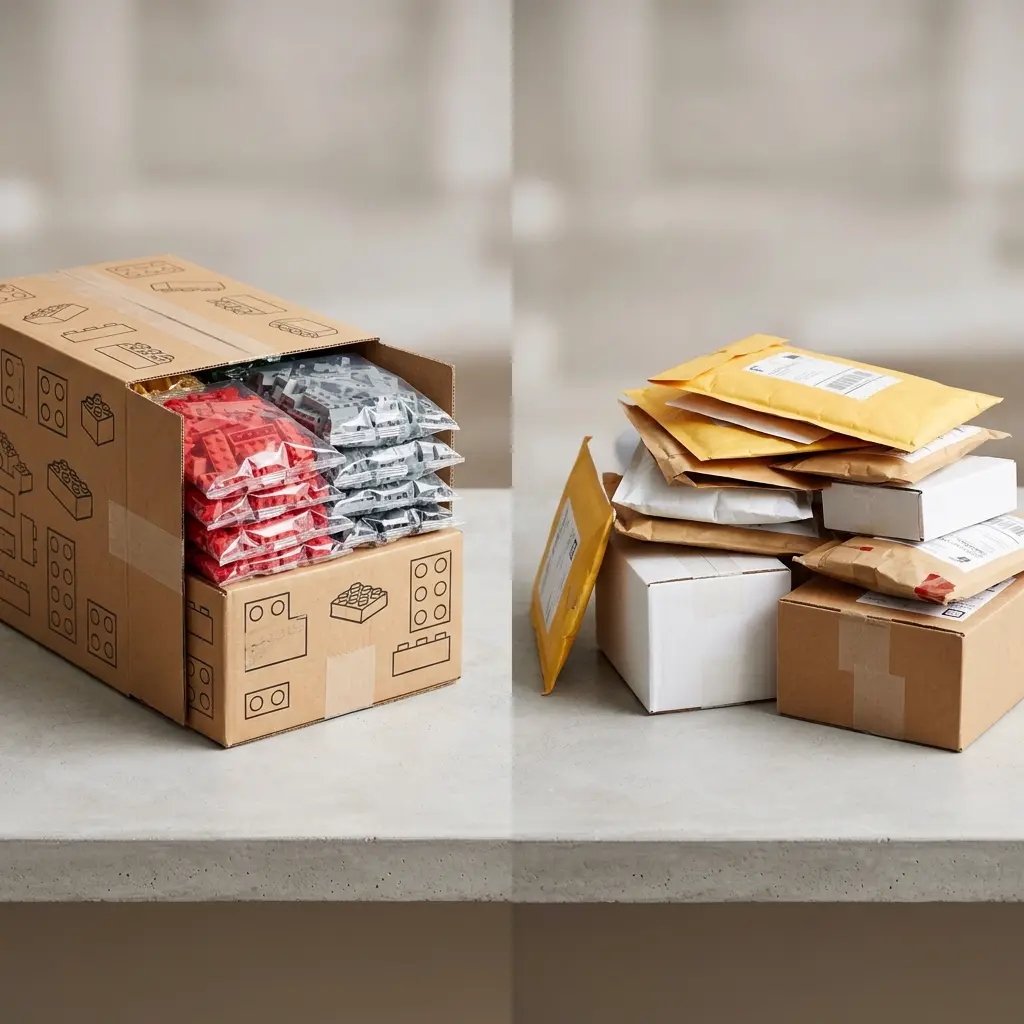
BrickLink vs Pick a Brick vs Webrick sourcing matrix
This table separates fixed catalog facts from marketplace behavior so the route comparison does not invent a BrickLink unit price.
| Dimension | LEGO Pick a Brick | Webrick | BrickLink |
|---|---|---|---|
| 3024 square plate price | $0.06 per 3024 plate | $0.03 per 3024 plate | Seller-dependent pricing by lot, color, condition, and shipping |
| 3024 square plate colors | 42 colors in the current catalog | 60 colors in the current catalog | Seller-dependent availability |
| 98138 round tile colors | 54 colors in the current catalog | 56 round-tile colors in the current catalog | Seller-dependent availability |
| Order complexity | Centralized route with simpler planning | Bulk compatible route with fixed catalog pricing | Can require multiple sellers and shipping decisions |
| Best use | Predictable current-stock base orders | Lower compatible bulk cost when palette fit is acceptable | Rare colors, replacement parts, and precision top-ups |
How each platform works
LEGO Pick a Brick is the most straightforward route when current official stock covers the needed colors. It is usually easier to explain, plan, and revisit because the unit price for 3024 square plates is fixed at $0.06 in the current runtime catalog.
Webrick is a compatible-parts route with lower fixed catalog pricing in this data: $0.03 per 3024 plate and $0.03 per 98138 round tile. The trade-off is that the project should be comfortable with compatible sourcing rather than only official-branded parts.
BrickLink is a marketplace. That flexibility is useful, especially for rare colors and partial top-ups, but a whole-project price depends on seller lots, shipping, condition, location, and stock timing. The runtime catalog does not provide a fixed BrickLink unit price, so this guide does not invent one.
Price comparison for a 48×48 mosaic
A 48×48 square-plate mosaic uses 2,304 pieces. At the current Pick a Brick 3024 price of $0.06, the parts baseline is $138.24 before any shipping or display hardware. At the current Webrick 3024 price of $0.03, the baseline is $69.12.
BrickLink can be cheaper, similar, or more expensive depending on the exact colors and sellers. It should be treated as a live marketplace check after the BMBrick parts list is stable, not as a fixed catalog route with one universal unit price.
How to use BMBrick export files
Use BMBrick to finalize crop, size, material style, and route estimate before shopping. Once the parts list is stable, export the route-specific files and use them to compare real order options.
For a deadline gift, Pick a Brick or Webrick may reduce decision overhead. For a slow precision build, BrickLink can be worth checking for rare colors and replacement quantities after the main order route is chosen.
How to turn this comparison into a real decision
The fastest way to misuse a comparison guide is to treat it like a ranking chart and ignore the context of the actual project. The better approach is to decide what matters most for this specific build first, then let the comparison answer that narrower question. Start with the route that matches your project risk: Pick a Brick for predictability, Webrick for lower compatible bulk cost, and BrickLink for rare colors, top-ups, or seller-dependent exceptions. If the project has a deadline, practical simplicity usually matters more than theoretical perfection. If the project is open-ended and highly personal, precision may deserve more weight than convenience.
A smart next step is to run one realistic test image all the way through the decision lens described above. Do not compare abstract possibilities forever. Compare one image, one crop, one likely room or gifting context, and one honest budget. That is where the trade-off becomes concrete. Once the decision is tied to a real image instead of a hypothetical one, the "best" option usually becomes much clearer.
- Define what you care about most before comparing the options: realism, ease, cost control, or room feel.
- Test one real image or project instead of debating the category in the abstract.
- Choose the option that reduces the biggest risk for this build, not the option that wins the most categories on paper.
If you want to pressure-test that choice from another angle, read PAB vs BrickLink and Square Plates vs Round Tiles. Those follow-up guides usually reveal whether the current decision still holds once source image, palette, or room context becomes more specific.
Use BMBrick to compare routes after the image is stable
The biggest sourcing mistake is trying to optimize a parts order for an image that still has avoidable background, weak crop, or an undecided material style.
BMBrick keeps the route estimate close to the visual decision, so you can see whether a cost difference is solving the real project problem or only making an unstable plan look cheaper.
FAQ
Is BrickLink cheaper than LEGO Pick a Brick for mosaic parts?
BrickLink can be cheaper for some colors and lots, but it does not have one fixed mosaic unit price. Pricing is seller-dependent and can change with shipping, seller location, condition, and how many separate lots the order requires. Use it as a marketplace check after your parts list is stable rather than as a guaranteed cheapest route.
When should I use LEGO Pick a Brick?
Use LEGO Pick a Brick when predictability matters and the current catalog covers the colors you need. In the current runtime catalog, LEGO Pick a Brick 3024 square plates are $0.06 per piece with 42 colors. That makes the route easy to budget for common square-plate mosaics before shipping and display hardware.
When should I use Webrick?
Use Webrick when compatible bulk pricing fits the project and you are comfortable sourcing compatible parts. The current catalog lists Webrick 3024 square plates at $0.03 per piece with 60 colors, and Webrick 98138 round tiles at $0.03 per piece with 56 round-tile colors. That can materially lower large mosaic parts cost.
Why does this guide avoid a fixed BrickLink price?
BrickLink is a seller marketplace, not a fixed-price route in the BMBrick runtime catalog. A real price depends on color, quantity, seller lot size, shipping, region, condition, and stock timing. Giving one fixed number would make the comparison less accurate, so the safer statement is seller-dependent pricing.
Should I combine Pick a Brick, Webrick, and BrickLink in one order?
A hybrid sourcing plan can work, especially when one route covers the bulk of the order and another route handles missing colors or top-ups. Keep it intentional. Use one primary route for most pieces, then use BrickLink or another route only for exceptions that improve the final result enough to justify extra order complexity.
Where To Go Next
Use these related guides to connect sourcing back to size and material style: