
Material Comparison
Square Plates vs Round Tiles for LEGO Mosaic: Visual Comparison and Guide
Square plates and round tiles create different mosaic surfaces even when the source image is identical. Square 3024 plates feel smoother and more continuous; round 98138 tiles make the brick texture and shadow rhythm more visible. The practical choice should include palette count and price, not only visual taste.
Direct answer: Use 3024 square plates for smoother portraits, fuller coverage, and predictable square-grid reads: 42 LEGO Pick a Brick colors at $0.06 per piece or 60 Webrick colors at $0.03 per piece. Use 98138 round tiles when visible texture and pop-art rhythm matter: 54 LEGO Pick a Brick colors at $0.03-$0.17 or 56 Webrick colors at $0.03 per piece.
Best for: Builders deciding whether the finished mosaic should read as a smoother portrait surface or as a more visibly textured brick object.
Avoid: Do not choose round tiles only because they look more playful if the portrait depends on soft facial transitions, and do not choose square plates if the project needs obvious material texture.
Recommended setup: Use square 3024 plates for realism-first portraits and use round 98138 tiles for graphic, modern, or intentionally textured wall art after checking palette and route availability.
Square 3024 Plates
Best when you want continuous color fields, cleaner faces, and the most classic mosaic read.
Round 98138 Tiles
Best when visible texture, shadow, and pop-art character are part of the intended design.
Route Facts Matter
The catalog shows different color counts and price behavior by part and route, so test the real project before ordering.
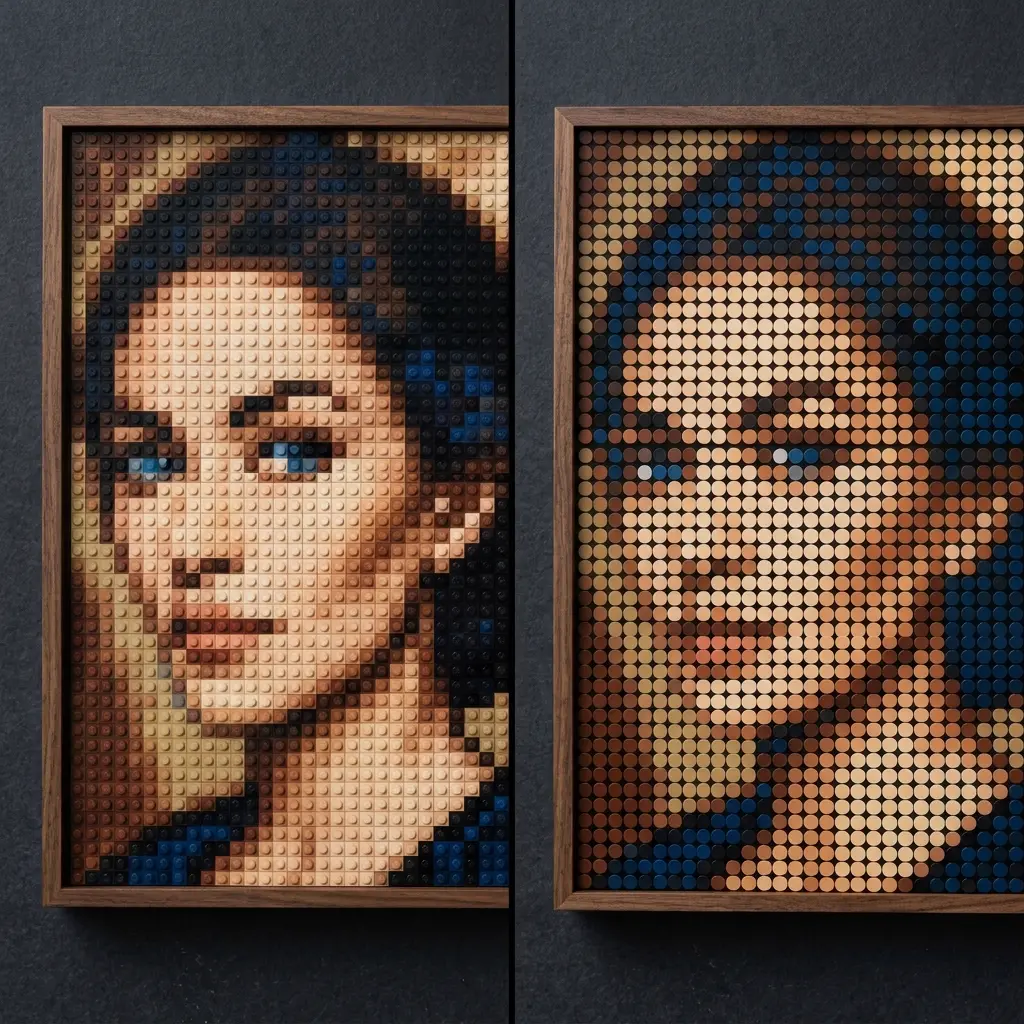
Square plates vs round tiles by route and use case
These facts come from the current runtime catalog for 3024 square plates and 98138 round tiles.
| Dimension | 3024 square plates | 98138 round tiles | Best fit |
|---|---|---|---|
| Surface read | Smoother, denser, more continuous | More dotted, textured, and shadowed | Square for realism, round for graphic texture |
| LEGO Pick a Brick color availability | 42 LEGO Pick a Brick colors | 54 LEGO Pick a Brick colors | Round has more current LEGO route colors in this catalog |
| Webrick color availability | 60 Webrick colors | 56 Webrick colors | Square has a slightly wider Webrick route palette |
| LEGO Pick a Brick unit price | $0.06 per 3024 plate | $0.03-$0.17 per 98138 round tile | Square is stable; round varies by color |
| Webrick unit price | $0.03 per 3024 plate | $0.03 per 98138 round tile | Both are fixed in this catalog route |
Visual difference in finished mosaics
Square plates cover more of the grid cell and make value changes feel more connected. This is why they are often safer for portraits, pets, and wedding gifts where likeness matters more than visible brick pattern.
Round tiles leave more visible separation between placements. That separation can make the surface feel lively and intentionally designed, especially under directional light, but it can also compete with subtle facial detail.
Palette and price differences
The current catalog gives LEGO Pick a Brick 42 colors for 3024 square plates and 54 colors for 98138 round tiles. Webrick shows 60 colors for 3024 and 56 colors for 98138. Those counts can change which route feels practical for a specific photo.
Price behavior also differs. LEGO 3024 square plates are fixed at $0.06 in this data, while LEGO 98138 round tiles range from $0.03-$0.17. Webrick is fixed at $0.03 for both 3024 and 98138 in the current catalog.
How to decide in BMBrick
Run the same crop with both material styles before ordering. If the eyes, mouth, or subject outline become harder to read with round tiles, square plates are the safer choice. If the image feels flat with square plates and the project wants visible rhythm, round tiles may be worth the texture.
The choice should happen after the crop is strong and before sourcing. A weak crop will not become strong because the material style changed.
How to turn this comparison into a real decision
The fastest way to misuse a comparison guide is to treat it like a ranking chart and ignore the context of the actual project. The better approach is to decide what matters most for this specific build first, then let the comparison answer that narrower question. Use square 3024 plates for realism-first portraits and use round 98138 tiles for graphic, modern, or intentionally textured wall art after checking palette and route availability. If the project has a deadline, practical simplicity usually matters more than theoretical perfection. If the project is open-ended and highly personal, precision may deserve more weight than convenience.
A smart next step is to run one realistic test image all the way through the decision lens described above. Do not compare abstract possibilities forever. Compare one image, one crop, one likely room or gifting context, and one honest budget. That is where the trade-off becomes concrete. Once the decision is tied to a real image instead of a hypothetical one, the "best" option usually becomes much clearer.
- Define what you care about most before comparing the options: realism, ease, cost control, or room feel.
- Test one real image or project instead of debating the category in the abstract.
- Choose the option that reduces the biggest risk for this build, not the option that wins the most categories on paper.
If you want to pressure-test that choice from another angle, read Square vs Round and LEGO Colors Guide. Those follow-up guides usually reveal whether the current decision still holds once source image, palette, or room context becomes more specific.
Use BMBrick to compare the same crop twice
BMBrick keeps the material-style decision tied to route estimates, so the visual preference and sourcing consequence stay visible together.
For portraits, compare the eye area first. For decor, compare room-distance readability and whether the surface texture supports the room.
FAQ
Are square plates better than round tiles for LEGO mosaic portraits?
Square plates are usually safer for portrait realism because they create a denser surface with smoother color fields. That helps faces read as faces instead of as separate dots. Round tiles can still work for portraits, but they make texture more visible, so they need stronger source lighting and a crop that protects the eyes and mouth.
Do round tiles have more LEGO Pick a Brick colors than square plates?
In the current runtime catalog, LEGO Pick a Brick has 54 colors for 98138 round tiles and 42 LEGO Pick a Brick colors for 3024 square plates. That does not automatically make round tiles better, because the useful palette depends on the photo, but it is a real sourcing difference to check before export.
Which option is cheaper, 3024 square plates or 98138 round tiles?
For LEGO Pick a Brick, 3024 square plates are fixed at $0.06 per piece in the current catalog, while 98138 round tiles range from $0.03-$0.17 depending on color. For Webrick, both 3024 square plates and 98138 round tiles are fixed at $0.03 per piece in the current catalog.
Do square plates and round tiles use the same number of pieces?
Yes for the same grid size. A 64×64 mosaic still uses 4,096 placements whether each placement is a square 3024 plate or a round 98138 tile. The difference is not piece count; it is texture, color availability, price behavior, and how the finished surface reads from normal viewing distance.
Should I mix square plates and round tiles in one mosaic?
Mixed-material mosaics can be interesting, but they are harder to plan and source cleanly. For most builders, choose one primary material style for the image first. If you experiment with mixing, limit it to a deliberate design effect such as highlights, borders, or background texture rather than changing parts randomly across the portrait.
Where To Go Next
Read these next if the material choice still feels close: